Structural Differences and Mechanical Behavior
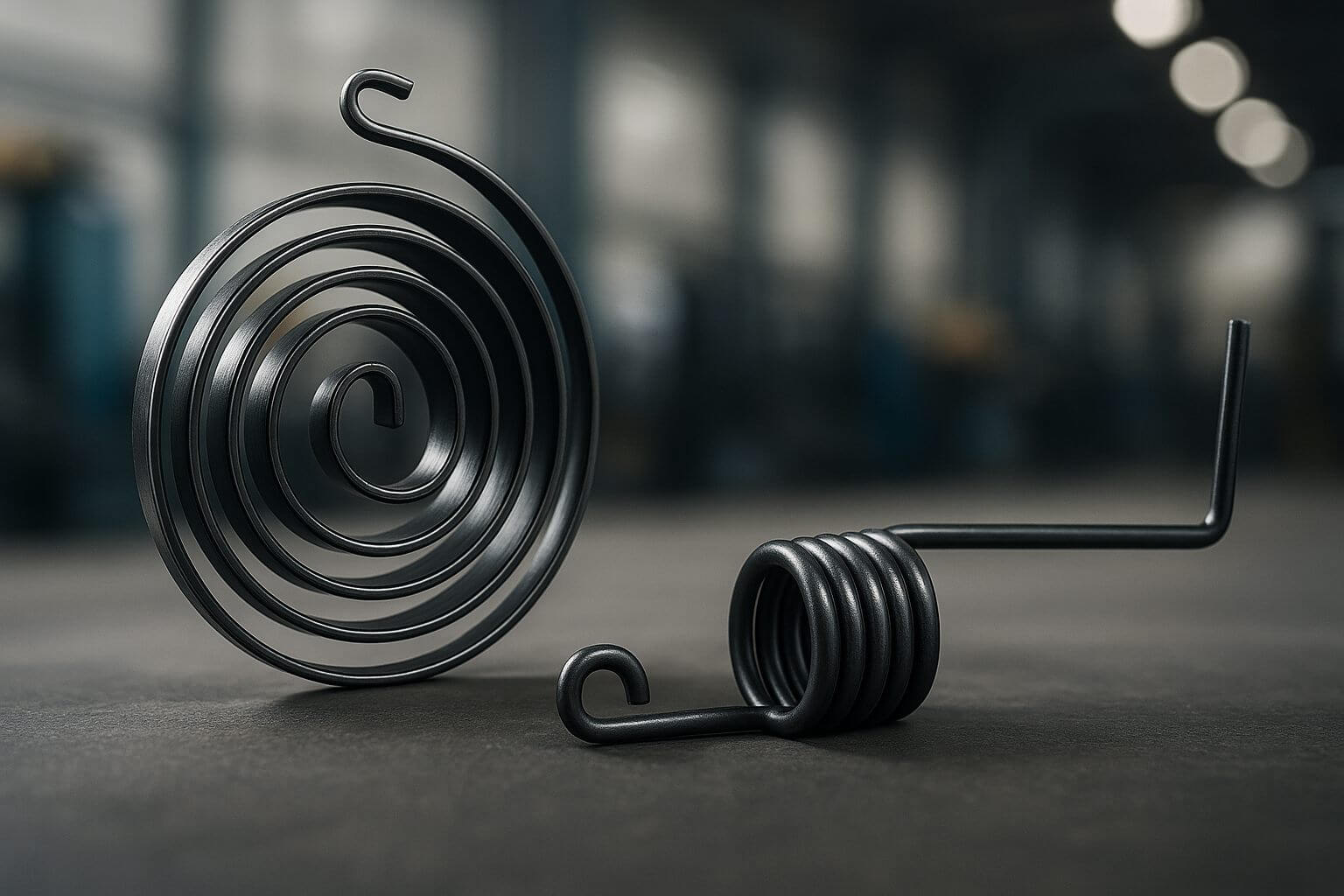
Clock springs and torsion springs both store rotational energy, but they do so in fundamentally different ways. A torsion spring works by twisting a round wire, generating torque through angular deflection. This mechanism is effective when the required rotation is limited and the load can be transferred through the arms of the spring.
A clock spring, by contrast, is made from a flat steel strip wound into a spiral. It winds and unwinds across multiple rotations, distributing stress evenly along the strip. This geometry allows a controlled release of torque with consistent force across a broader rotational range. Because the spring rotates around its own axis, it delivers stable motion without the sharp stress concentrations that can occur in wire-based torsion designs.
When Clock Springs Offer a Functional Advantage
Clock springs become the preferred solution when a mechanism requires more rotation, a compact profile, or repeatable torque delivery across many cycles. Since the strip coils flat, the spring maintains stability even under continuous movement, making it suitable for systems that rely on precise and repeatable rotational force.
In assemblies where a torsion spring would reach its angular limit or experience excessive wear, a clock spring can accommodate greater travel while maintaining torque accuracy. This makes it a practical choice for designs where space is restricted, but performance requirements remain high.
Also read – The use of clock springs in industrial applications
Torque Characteristics and Space Efficiency
The design of a clock spring allows a high torque output relative to its installed height. Because the layers of the coil stack efficiently, the spring can deliver strong rotational force within minimal axial space. This is often decisive in compact actuators, instrument mechanisms, or rotary modules where internal layout is tightly constrained.
A torsion spring generally requires more space, as the arms must be positioned to transfer load effectively. In comparison, the self-contained shape of a clock spring supports more straightforward integration into small housings or enclosed units.
Industrial Applications Where Clock Springs Excel
Clock springs were originally developed for timekeeping mechanisms, but their usefulness extends across many modern industries. They are now applied in automotive systems, electrical assemblies, and compact industrial equipment where controlled rotational energy is required.
In automotive modules, their ability to rotate while maintaining stable force makes them suitable for systems that combine movement and signal transfer. In manufacturing equipment, they support return mechanisms, tensioning systems, and precise alignment features. Electrical components may use clock springs to manage cable retraction or maintain consistent resistance during rotation. Clock spring suppliers like Hagens provide these components in precisely engineered configurations to ensure stable torque delivery and reliable performance across compact mechanical and electromechanical systems.
Material Considerations and Durability
Every clock spring produced at Hagens is made from materials selected for strength, durability, and fatigue resistance. The strip must support repeated winding and unwinding without deformation. For demanding environments, stainless steel or specialized alloys are used to ensure stable performance under corrosion or temperature influence.
Because of the distributed stress pattern, clock springs typically demonstrate long service life when correctly specified. Their predictable mechanical behaviour supports reliable operation across high cycle counts, reducing maintenance requirements.
Selecting the Right Component for System Requirements
Engineers often choose clock springs when the design calls for:
- extended rotational movement
- compact torque storage
- consistent force over multiple cycles
- limited installation space
- controlled release of rotational energy
Where applications require only limited angular deflection, or where arm geometry is integral to the mechanism, a torsion spring may still be the appropriate choice. When the need shifts toward precision, compactness, and smooth rotational output, the clock spring provides clearer advantages.
Custom Configuration for Application-Specific Needs
Many industrial systems require springs designed for unique torque ranges, rotational angles, or mounting constraints. Hagens offers both standard and fully customized configurations to match these requirements. Most of the springs we produce here at Hagens are custom springs. Each spring is engineered according to the intended operating environment, including load cycles, material selection, and necessary surface treatments.
The development process ensures that every unit integrates seamlessly into the customer’s system, whether used in a compact electrical device or a demanding mechanical assembly.
Reliability in Long-Term Operation
Clock springs maintain mechanical stability over extended periods, even under demanding conditions. Their structure reduces fatigue and ensures predictable wear, making them suitable for components where consistent function is essential to system uptime. Thorough testing verifies torque accuracy and durability so each spring operates reliably throughout its lifecycle.
Why Engineers Choose Clock Springs
Clock springs offer a dependable combination of compact design, controlled rotational force, and long-lasting performance. When a torsion spring cannot provide the necessary rotation or when space constraints demand a flatter, layered spring form, the clock spring is the more effective option.
With Hagens’ focus on material quality, precision engineering, and documented production processes, each clock spring is developed to meet the functional requirements of modern mechanical and electromechanical systems.