Wear indicator brake pads are one of the most widely used safety features in modern vehicles. Yet the component that makes the warning possible — the indicator clip itself — rarely gets the attention it deserves until something goes wrong.
Understanding what separates a reliable brake wear indicator from a poor one matters both for vehicle safety and for the procurement teams and engineers who specify these components.

The job sounds simple. The execution is not.
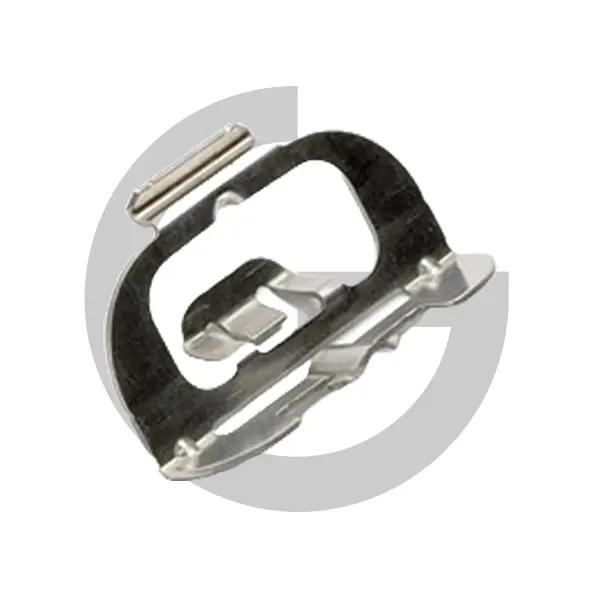
The purpose of a brake wear indicator is straightforward: stay silent under normal conditions, and produce an unmistakable signal when the brake pad friction lining reaches its minimum serviceable thickness — typically around 2–3 mm. At that point, the indicator makes contact with the rotor, and the driver hears the familiar squeal that means it is time to service the brakes.
But wear indicator brake pads operate in a demanding environment. The indicator clip is exposed to continuous heat cycles, road vibration, water, salt, brake dust and the mechanical stress of thousands of braking events before it ever needs to perform its primary function. By the time it matters, the component has already been through conditions that would degrade a poorly specified part beyond reliability.
A disc brake wear indicator that contacts the rotor too early generates false alarms and erodes driver trust in the warning system. One that is too soft may deform before it signals at all. The difference between the two is almost entirely in the precision of the spring steel specification, the accuracy of the forming process, and the consistency of heat treatment across production runs.
Mechanical and electrical — two systems, the same demand for precision
Most people associate the brake wear indicator with the audible squeal produced by a mechanical clip. But a growing share of modern vehicles — particularly passenger cars and light commercial vehicles — use an electrical brake pad wear indicator instead: a sensor wire mounted in the pad body that breaks a circuit when the lining wears through to the contact point, triggering a dashboard warning light.
Both systems work. Both require the same underlying precision. For the mechanical brake lining wear indicator, the geometry of the clip and its spring rate are the critical variables. For electrical systems, the placement of the sensor element relative to the lining surface determines whether the warning triggers at the correct moment. Tolerance errors in either system translate directly to safety risk.
The right supplier understands both configurations — and can deliver them to the same quality standard.
Beyond the car – brake wear indicators in industrial applications
Wear indicator brake pads and the indicators that serve them are commonly associated with disc brake systems on passenger vehicles. But brake monitoring is equally critical in heavy industrial settings: wind turbines, cranes, hoists and material handling equipment all rely on friction braking systems where unmonitored wear can lead to catastrophic failure.
In these environments, the operating conditions are often more severe than anything a road vehicle encounters — longer periods of continuous load, higher temperatures, more aggressive duty cycles. A brake shoe wear indicator deployed in a wind turbine nacelle or a port crane does not get serviced on a regular workshop schedule. It has to be right the first time, with a service life that matches the application.
Sourcing wear indicators from a manufacturer with genuine experience across both automotive and industrial applications is not a minor distinction. It means the engineering understanding behind the component extends beyond the passenger car context where most brake component suppliers operate.
What to look for when specifying brake wear indicators
For procurement engineers and technical buyers specifying wear indicator brake pads at the component level, the relevant criteria go beyond price and availability:
Material specification and traceability — What steel grade is used, and is heat treatment documented and validated per batch? Automotive-grade spring steel is not a generic commodity.
Dimensional consistency — Small deviations in clip geometry translate to variation in contact timing. Tolerance control at production scale is what separates an OEM-grade component from an aftermarket approximation.
Environmental performance — Salt spray, temperature cycling, and vibration resistance should all be validated for the specific application, not assumed from general product descriptions.
Application-specific design — A brake wear indicator designed for a commercial vehicle disc brake operates under different conditions than one intended for a drum brake system or an industrial hoist. The component should be engineered for the application, not adapted from a standard catalogue.
Quality certification — For automotive supply chains, IATF 16949 compliance is a baseline expectation. For industrial applications, the relevant certifications will depend on the sector and geography.
Precision manufacturing as a differentiator
The brake wear indicator is a low-cost component in the context of a complete braking system. But it carries safety-critical responsibility disproportionate to its unit price. That gap — between component cost and functional consequence — is exactly where manufacturing precision matters most.
Wear indicator brake pads perform reliably when every part of the system is engineered and produced to a consistent standard. For the indicator itself, that standard is set at the manufacturing stage, before the part ever reaches a vehicle or machine.
Hagens produces brake wear indicators as precision stamping parts, in both mechanical and electrical configurations, for automotive OEM, tier-one and industrial customers. Tailored solutions are developed in close collaboration with customer engineering teams to meet specific application requirements.