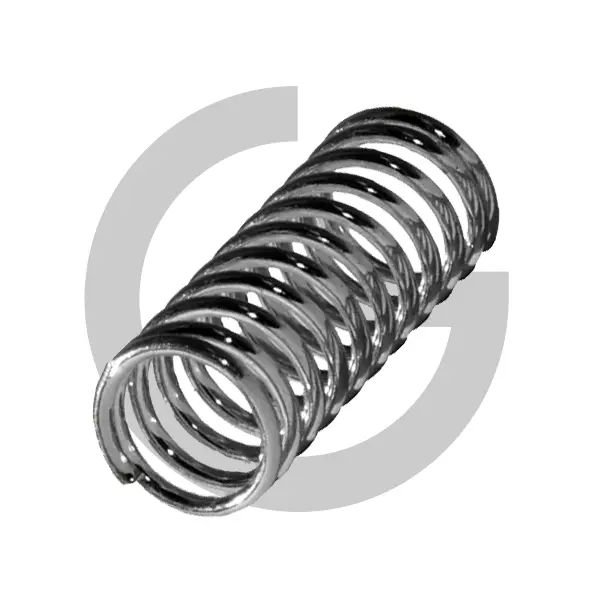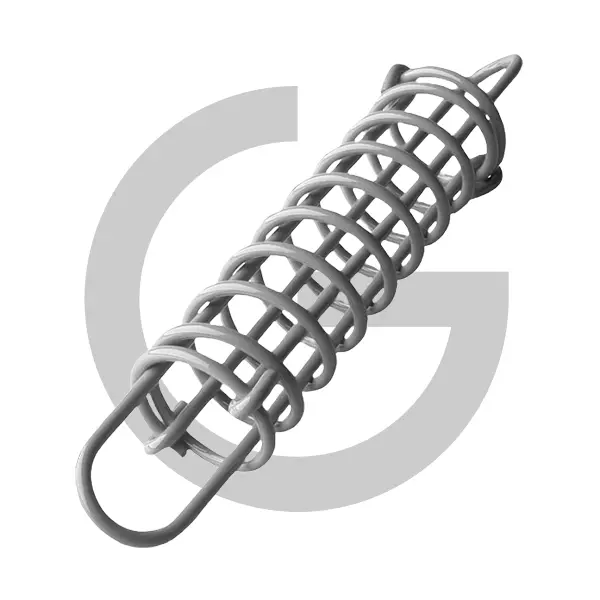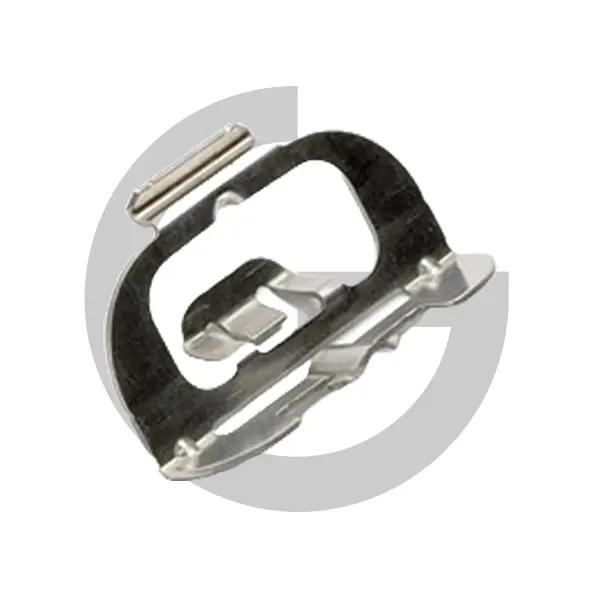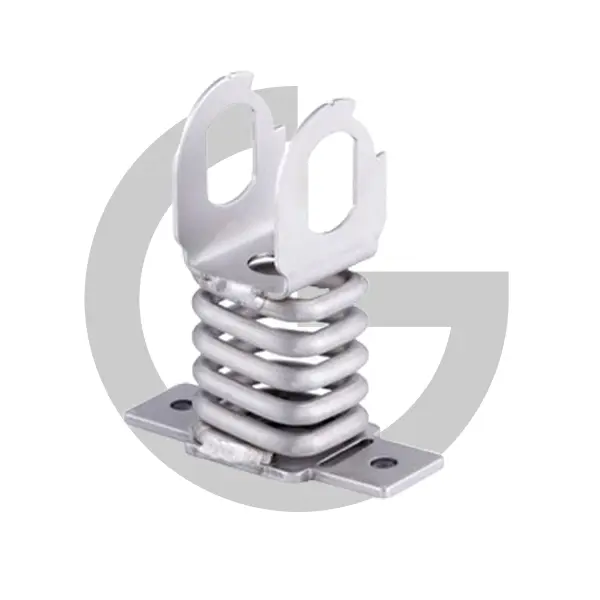
A pressure relief valve on a chemical reactor needs to hold seat at 14 MPa, then open reliably at 14.5 MPa — every cycle, for years. The envelope is tight: 38 mm OD, barely 4 mm of axial space. The engineer specifying the spring package has two realistic candidates on the table: a stack of disc springs or a multi-turn wave spring. Both fit the bore. Both can hit the load. But they will behave very differently in service, and choosing wrong means either a valve that leaks or one that won’t lift.
This is the kind of decision our engineering team works through with customers daily. Below is the technical framework we use.
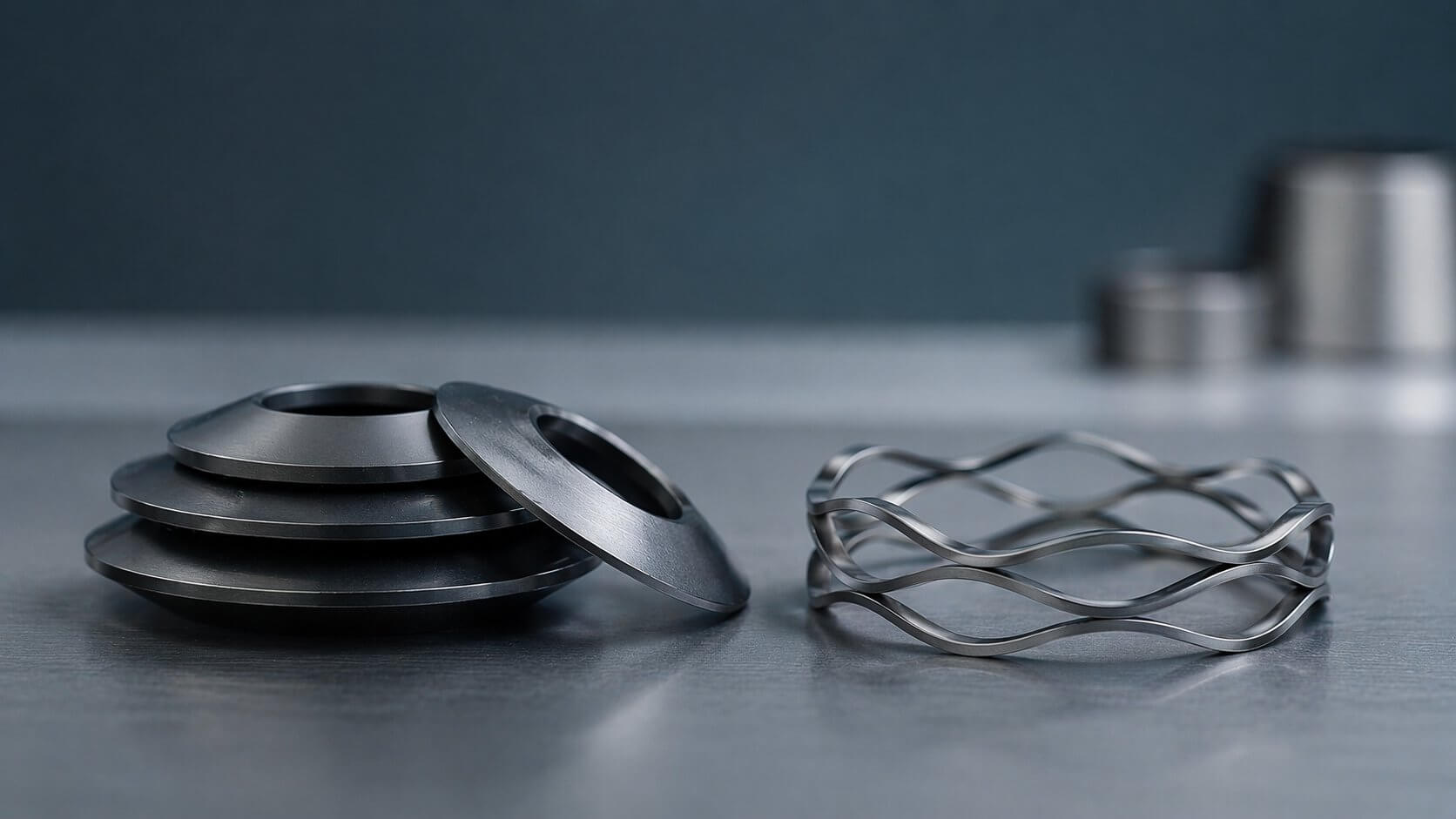
What Are Disc Springs?
A disc spring — also called a Belleville washer or conical disc spring — is a conical, washer-shaped element that generates high force over a very short deflection. Disc springs conform to DIN 2093 (now DIN EN 16983) and are typically manufactured from 51CrV4 spring steel (AISI 6150) with a phosphate and oil finish as standard, though stainless steel variants are common where corrosion resistance matters.
What makes disc springs unique is their load-deflection relationship. A single disc spring can support loads orders of magnitude greater than a coil spring of comparable outer diameter, but total travel is typically limited to a fraction of the disc thickness. The load curve is often non-linear — it can even be designed to be nearly flat over part of the deflection range, which is exactly why they show up in safety valves and bolted joint compensation.
Manufacturing quality matters here. Every disc spring should undergo pre-setting: the disc is completely flattened, and any disc that does not recover its designed free height is discarded. For discs with a material thickness exceeding 6 mm, DIN 2093 specifies that supporting surfaces should be machined to ensure proper load distribution.
The real versatility of disc springs comes from stacking. Parallel stacking — nesting two discs in the same orientation — doubles the load at the same deflection. Three in parallel triples it. Series stacking (alternating orientation) increases total deflection while maintaining the single-disc load rating. By combining parallel and series groups, engineers can build a spring package tuned precisely to the required force-deflection curve.
Learn more about our disc spring range
What Are Wave Springs?
Wave springs deliver the same force as traditional compression springs in a significantly smaller axial envelope — reducing operating height by up to 50% compared to an equivalent coil spring. That space saving is the primary reason engineers specify them.
There are several configurations. Single-turn wave springs are typically manufactured from round spring material and suit light preload duties. Multi-turn wave springs are produced from flat spring wire and are available in a wide range of sizes and materials. Nested wave springs — multiple turns layered within the same radial footprint — increase load capacity without adding height.
From a performance standpoint, wave springs offer a more linear spring rate than disc springs, particularly between 30% and 70% of total deflection. They compress only axially with no torsional action, which means less wear on mating surfaces — a real advantage in bearing preload and seal-loading applications. They can also be toleranced roughly 50% tighter than stamped disc springs, which matters when you need precise, repeatable force in a compact assembly.
Explore our wave spring solutions
Head-to-Head Comparison
| Parameter | Disc Springs | Wave Springs |
|---|---|---|
| Load capacity (relative to OD) | Very high — orders of magnitude above coil springs | Moderate — higher than coil springs, lower than disc springs |
| Deflection range | Very short (fraction of disc thickness) | Short to moderate (up to 50% height reduction vs coil) |
| Load-deflection curve | Non-linear; can be tuned flat via stacking | More linear (especially 30-70% range) |
| Tolerancing | Standard stamping tolerances | ~50% tighter than stamped disc springs |
| Axial space required | Minimal per element; stackable | Minimal; single element replaces coil spring stack |
| Torsional action | Present under compression | None — purely axial compression |
| Wear on mating surfaces | Moderate (friction between stacked discs) | Low (no rotation during compression) |
| Standard materials | 51CrV4 / AISI 6150; stainless steel | Flat wire or round wire; various alloys |
| Governing standard | DIN 2093 / DIN EN 16983 | Application-specific |
| Tunability | Parallel and series stacking combinations | Multi-turn count, wave number, nested layers |
| Best for | High load, short travel, bolted joints, safety valves | Bearing preload, seals, compact assemblies |
When to Choose Disc Springs
Disc spring applications cluster around scenarios that demand high force in minimal axial space, often with a requirement for precise, repeatable behavior under static or dynamic loading.
Safety valves and pressure relief. The non-linear characteristic of a disc spring stack lets valve designers set a narrow band between seating force and opening force. This is why disc springs are standard in safety-critical pressure systems across chemical processing and energy generation.
Bolted joint compensation. Thermal cycling, creep, and vibration all relax bolted joints over time. A disc spring washer under the bolt head maintains clamp load as the joint settles. This is routine in flanged pipe connections, engine assemblies, and structural steel work.
Braking systems. From train brakes to heavy machinery, disc springs provide the failsafe return force that ensures braking engagement even if hydraulic pressure is lost.
Vibration damping in heavy machinery. Stacked disc spring assemblies absorb shock loads in presses, rolling mills, and ship engines where the forces involved would flatten a conventional coil spring.
Thermal expansion compensation. In applications where components expand and contract with temperature — think turbine casings, heat exchangers, exhaust systems — disc springs maintain a controlled preload across the thermal range.
The key decision driver: if the load is high relative to the available space and the deflection requirement is small, a disc spring or disc spring stack is almost certainly the right choice.
When to Choose Wave Springs
Wave springs earn their place in designs where radial and axial space restrictions are tight and the required loads are moderate.
Bearing preload. A multi-turn wave spring sitting behind an outer bearing race delivers consistent, precisely toleranced preload force without the axial height penalty of a coil spring. This is common in electric motors, gearboxes, and pump assemblies.
Seal loading. Mechanical seals need a controlled, uniform face load. The linear spring rate of a wave spring between 30% and 70% deflection makes force predictable across the wear range of the seal face.
Compact assemblies and miniaturized devices. Medical devices, valve actuators, and precision instruments often cannot accommodate a coil spring’s height. Wave springs fit where nothing else will, and the absence of torsional action means they won’t twist delicate internal components.
Clutch and brake return springs. In automotive and agricultural equipment, wave springs serve as return elements in clutch packs where the purely axial compression characteristic prevents the scuffing that a coil spring’s torsion would cause.
The key decision driver: if the force requirement is moderate, the space is severely constrained, and you need a linear, repeatable spring rate with tight tolerance, wave springs are the better fit.
Can You Combine Both in One System?
Yes — and it is more common than most engineers expect. Complex assemblies often have distinct zones with different mechanical demands. A heavy-duty valve might use a disc spring stack on the main closure element for high seating force, while a wave spring provides light preload on a secondary seal or position sensor in the same housing. Each spring type works in its optimal range, and the overall system benefits from both.
The practical constraint is ensuring that each spring zone is mechanically isolated so that the deflection characteristics of one do not interfere with the other.
How Hagens Supports Your Selection
Since 1945, our engineering team has been designing and manufacturing both disc springs and wave springs — along with compression, tension, and specialized spring types — for customers in automotive, medical, industrial, and agricultural sectors. We are a third-generation, family-owned disc spring manufacturer and supplier, and our production is certified to ISO 9001, ISO 14001, ISO 45001, IATF 16949, and ISO 13485.
What this means in practice: if a standard Belleville disc spring does not match your bore, load, or envelope, we produce custom sizes. Our wave springs are customized to meet exact technical specifications, and our engineers work alongside your team to find the spring design that satisfies your mechanical, spatial, and material requirements — whether that is a single disc spring, a complex stacking arrangement, or a precision wave spring in an exotic alloy.
We would rather help you select the right spring type upfront than replace the wrong one later.
Conclusion: A Decision Framework
The choice between disc springs and wave springs comes down to three questions:
- How much force, relative to the available space? If the load is very high and the deflection is very short, disc springs win. If the load is moderate and the envelope is severely constrained in both axial and radial directions, wave springs are the better option.
- What shape of load curve do you need? Non-linear or flat-load characteristics point to disc springs. A linear, predictable spring rate favors wave springs.
- How tight are your force tolerances? Wave springs can be toleranced approximately 50% tighter than stamped disc springs. For applications where force repeatability is critical — bearing preload, seal faces — that precision matters.
When the answer is not obvious, talk to a spring engineer. That is what we are here for.