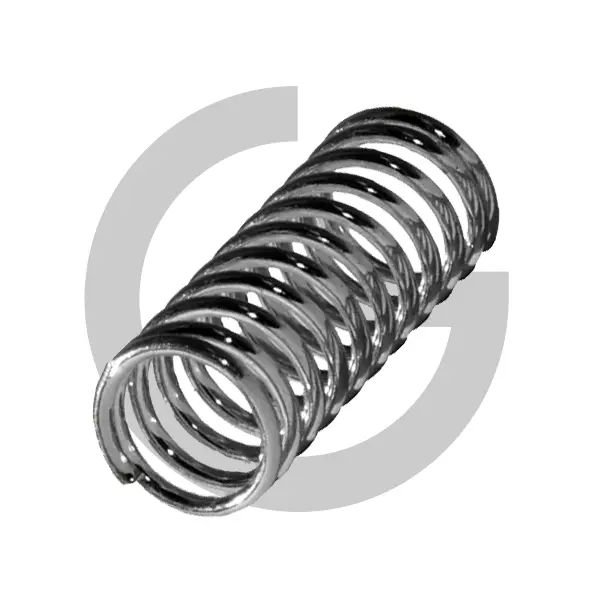
A die spring and a disc spring can drop into the same bore on a stamping tool, but they solve very different problems. A die spring is a heavy duty helical coil built to take repeated stroke under high load, typical of a punch returning to top dead centre several hundred times an hour. A disc spring is a conical washer, also called a Belleville washer, that delivers very high force over a short deflection and excels at maintaining preload across a bolted joint or a clamping interface.
The short answer first: pick a die spring when the spring needs to move, and a disc spring when the spring needs to hold.
The rest of the selection comes down to two reference points every tooling engineer should know by heart. The first is the ISO 10243:2019 colour code that tells you the duty class of a die spring at a glance. The second is the DIN EN 16984 (formerly DIN 2092) calculation rules that let you reshape the load curve of a disc spring without changing the disc itself. Both are international standards, both are portable across suppliers, and together they cover the great majority of high-load spring selection in tooling and clamping work.
Two springs built for very different jobs
The mechanical difference is bigger than the visual one. A typical red ISO 10243 die spring (heavy duty) with a 32 mm outside diameter delivers somewhere around 1500 to 1700 N at 20 percent deflection over a free length of 64 mm, giving you roughly 13 mm of usable stroke per cycle at long service life. A single 32 mm disc spring at the same outside diameter delivers a comparable peak force but only a few tenths of a millimetre of travel. To match the die spring on travel you would need to stack six or more discs in series, and even then the load curve looks nothing like a coil spring response.
That difference shapes where each one belongs. Hagens supplies heavy-duty die springs for stamping tools, stripper pads, draw cushions and clamping fixtures where the spring repeatedly compresses and releases under load. Disc springs go into bolt preload assemblies, lock-up clutches, valve actuators and any joint where you need to keep tension constant while components expand, contract or wear in. Mixing those use cases is the most common cause of premature spring failure on the production floor, because a disc spring stacked deep enough to give real travel becomes unstable, and a die spring used as a static preload device sets within weeks.
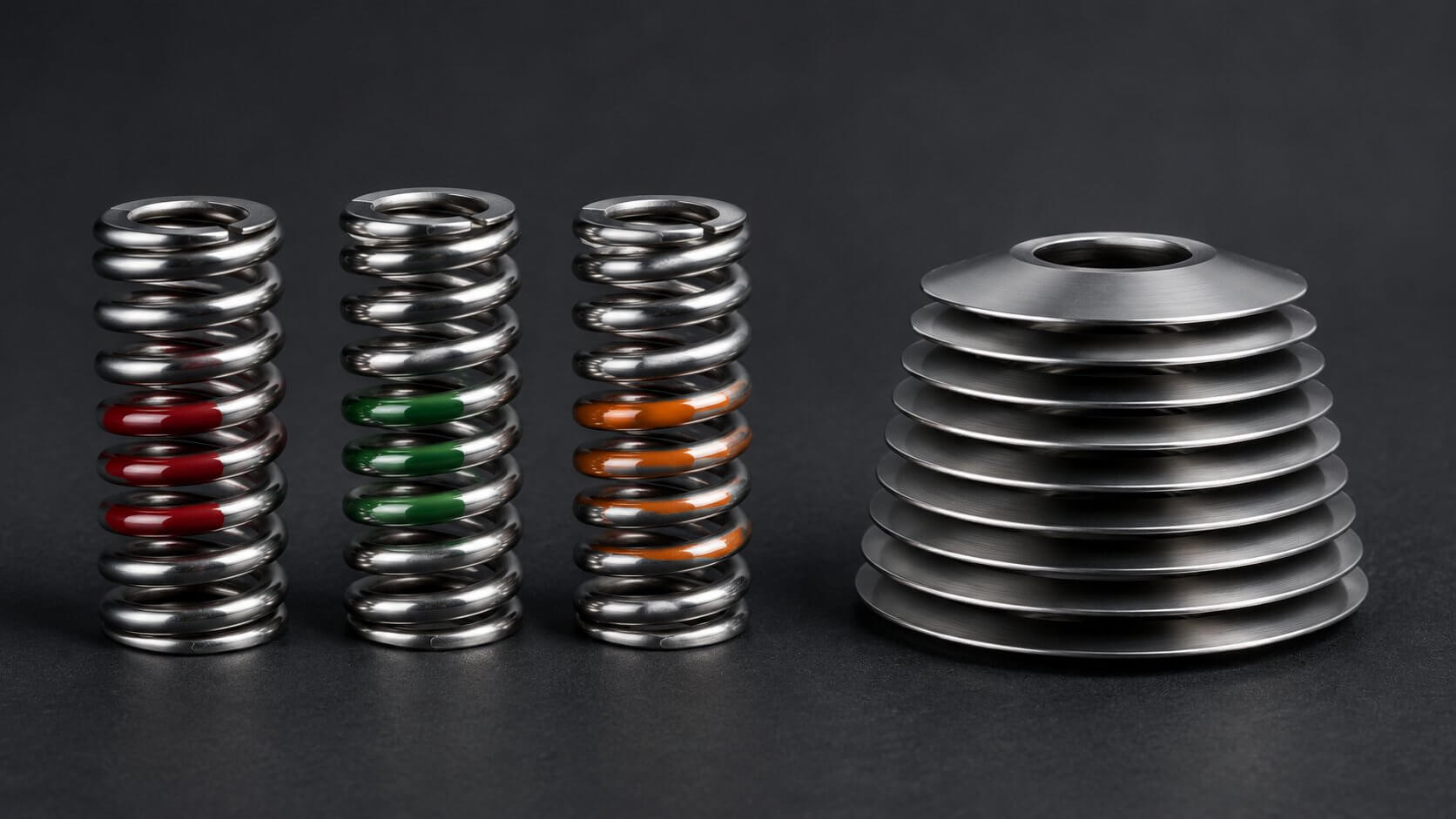
Reading the ISO 10243 colour code on die springs
ISO 10243:2019 standardises die springs into four duty classes, each marked with a paint band on the outside of the coil so a tooling fitter can identify the spring at a glance even after years of service. The colour tells you two things at once: the rated load class and the maximum travel as a percentage of free length before the coil takes permanent set or loses its rated fatigue life. A tooling engineer who knows the colour code can size a return spring against a known bore in under a minute, which is why the standard has survived for decades with only modest revisions.
| Colour | Duty class | Max travel (% of free length, long service life) | Typical use |
|---|---|---|---|
| Green | Light | 25 % | Light return springs, pad lifters, ejector springs |
| Blue | Medium | 24 % | Stripper pads, light forming, mid-load returns |
| Red | Heavy | 20 % | Most stamping returns, blanking strippers, draw pads |
| Yellow | Extra heavy | 16 % | Heavy forming, large blanking dies, high preload returns |
Some manufacturers add brown (extra light) below green and orange or white (extra-heavy beyond yellow) for hyper-load applications, but those are vendor extensions and not part of the ISO 10243 standard itself. The percentages above are the long service life travel limits roughly equivalent to the F1 figure in the ISO load tables, and a medium service life rating allows another 25 percent or so of travel at the cost of fatigue life.
The practical reading of the table is that the colour with the highest force rating also gives you the least usable travel. A yellow die spring in the same bore as a green one will hit a hard stop on the punch four or five times sooner if you try to use the same stroke length. That is why tool designers usually size the bore first, calculate the required force at the chosen stroke, and then pick the colour that meets the force without exceeding the percentage travel limit. Picking the colour first and adjusting the tool around it is the classic mistake that ends with broken coils six months into a production run.
Also read: Disc Springs vs Wave Springs
Stacking disc springs to shape the load curve
A disc spring on its own gives you a small, very stiff response. The interesting engineering comes from how you stack them, and DIN EN 16984 (formerly DIN 2092) lays out the calculation rules that every disc spring manufacturer follows. Two stacking modes change the behaviour entirely and you can combine them in the same column:
- Series stacking (each disc faces opposite to the next) multiplies travel: N discs in series give N times the deflection at the same load as a single disc.
- Parallel stacking (discs nest cup-against-cup) multiplies force: N discs in parallel give N times the load at the same deflection.
- Combined stacks (groups of parallel pairs put in series) let you dial in almost any load-travel curve within the disc envelope.
That gives you a design freedom no other spring type offers in the same envelope. A 50 mm bore that needs 8 mm of travel at 12 kN can be built with eight discs in series, or with four pairs of two-in-parallel-then-in-series for a steeper initial curve and a softer final response. The cost of this flexibility is friction between the discs, which is why industry practice limits parallel stacks to roughly three to five discs before heat and wear become significant. DIN EN 16983 (formerly DIN 2093) lists the dimensions and forces for every standard disc, so for any envelope you have a finite set of building blocks, and the engineering job is to combine them rather than to design a coil from scratch.
Stroke or preload: how to choose in 2 questions
Two questions cover most selection decisions. First, does the spring need to travel more than 2 mm per cycle? If yes, you are in die spring territory regardless of the load, because a disc spring stack deep enough to give real travel becomes mechanically unstable and burns through cycles on internal friction. Second, does the spring need to hold a defined force when the assembly is not moving, with very little change as components creep or wear? If yes, you are in disc spring territory, because a coil spring under static preload relaxes over time and the load drops in a way that a stacked disc package does not.
The combinations of those two answers map cleanly onto the design space. Long stroke with dynamic cycling picks a die spring sized by the ISO 10243 colour, every time. Short travel with a hard preload requirement picks a disc spring stack sized by DIN EN 16983. Long stroke with a critical preload requirement, which sounds contradictory but shows up in clamping fixtures, usually splits the job in two: a die spring carries the stroke, a small disc spring stack sits in series to hold the preload constant. Short travel with no preload requirement is the only case where personal preference and cost decide, and even there die springs win on assembly time because they drop in as a single part.
Where each spring fails: 3 patterns to watch
Die springs fail in three recognisable patterns and each one tells you something useful about the install:
- Loss of free length (set). The colour class was wrong for the actual stroke. Step up one colour (green to blue, blue to red) and re-check the force at the new free length.
- Coil breakage at the inner diameter. The guide rod is missing or undersized, and the spring is grinding against the bore wall. Fretting cracks propagate from the inside out and the coil snaps mid-stroke.
- Surface scoring along the outside of the coil. The bore is too tight, and the spring is being squeezed every cycle. Open the bore by 0.5 to 1 mm or step down to the next standard outside diameter.
Disc springs fail differently and most of the patterns trace back to preload, not to the disc itself:
- Flattening under high preload. The stack is taking permanent set because the calculated maximum force was exceeded. Re-run the DIN EN 16984 stack calculation against the actual bolt torque.
- Edge contact wear at the inner and outer rims. The discs were specified without contact flats, and stress concentration at the edge is grinding material away. DIN EN 16983 specifies contact flats as standard for discs thicker than 6 mm (Group 3).
- Loss of preload over time. The bolt or the joint is creeping, not the disc. The disc stack is doing its job by chasing the lost tension, and the fix is in the joint design.
Hagens manufactures custom disc springs with the contact flats and material grades required for ISO 13485 medical work as well as standard industrial duty. The most useful habit a tooling engineer can build is to specify the colour or the DIN class on the bill of materials rather than a part number from one supplier. A die spring with a red ISO 10243 band from any compliant manufacturer will fit, load and travel the same way in your tool, and a DIN EN 16983 disc spring with the right dimension code will stack and load the same way regardless of who made it. That portability is the entire point of the two standards, and it is the strongest argument for treating ISO 10243 and DIN EN 16983/16984 as the first reference any time you open a new tool design.