The short version: a wave spring wins when travel is short and axial room is tight. A coil spring wins when you need real stroke or the lowest possible piece price.
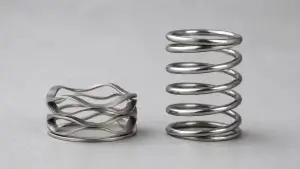
What makes a wave spring shorter than a coil?
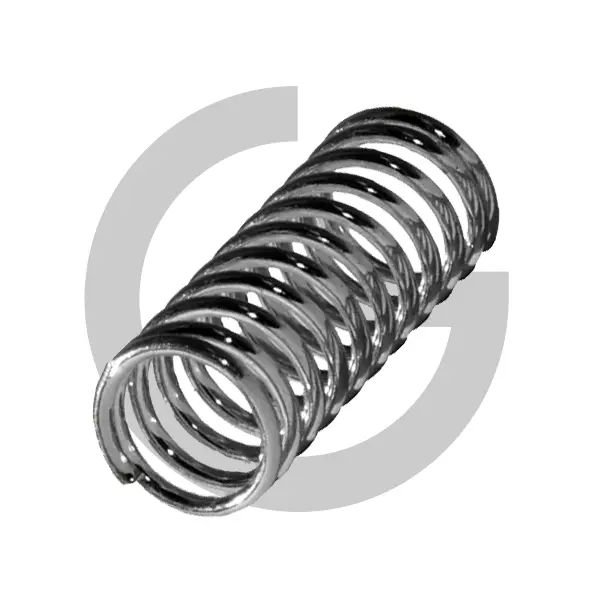
A conventional compression spring is coiled from round wire, so every active turn stacks a full wire diameter of height whether the spring is working or not. A wave spring is formed from flat wire wound on edge, with a series of waves pressed into each turn so the crests of one turn bear against the crests of the next. Because flat wire is thin in the axial direction and the waves do the work of storing energy, you remove most of the dead height that round wire carries. The spring reaches the same load through the deflection of the waves rather than through a tall stack of coils.
That construction also changes how the spring behaves under load. A single-turn wave spring gives a stiff, almost flat response and suits a simple gap-filling or preload job. A multi-turn crest-to-crest wave spring behaves much more like a coil spring, with a longer, more progressive travel. You tune it by changing the number of waves per turn and the number of turns: more waves raise the spring rate and lower the deflection per turn, fewer waves do the reverse. That is the lever an engineer uses to hit a target force at a target work height without touching the bore diameter.
How much axial space you really save
The headline figure is real but conditional. In a static application, where the spring sets a preload and rarely moves, a wave spring typically needs only about 50 percent of the work height of an equivalent coil spring at the same force and deflection. A 40 mm tall coil holding a bearing preload can often be replaced by a wave spring around 20 mm tall in the same bore, which lets the housing designer shorten the assembly or add clearance elsewhere. That is a genuine packaging win, not a rounding error.
Dynamic duty changes the maths. When the spring cycles repeatedly, extra turns have to be added to keep the bending stress in the flat wire below the fatigue limit, so the practical saving drops to roughly 30 percent rather than 50. It is still worth having, but in practice a cyclic wave spring sized from the static figure will either overstress the wire or fall short on life. Wave springs also carry an advantage that is easy to miss in a raw height comparison: their force curve stays broadly linear between about 30 and 70 percent deflection, a wider linear band than either coil or disc springs offer, which makes it easier to hold a specified load across normal assembly tolerance. Where you need long travel instead of tight tolerance, standard compression springs remain the more forgiving starting point.
When a coil spring is still the right call
A wave spring earns its height saving by trading away stroke. Three things send you back to a coil, and it pays to check all three before you commit the geometry:
- Long travel. Pushed past its linear region, a wave spring flattens and the waves begin to fret against each other. Long-stroke returns, suspension-style movement and any job that moves more than a few millimetres per cycle belong to a coil.
- Free-standing operation. Flat wire wound on edge wants a bore or a shaft to stay aligned. A coil spring is happy working in open air between two flat faces, where wave springs tend to buckle without a guide.
- Piece price at volume. On a high-volume part with generous vertical room, a round-wire coil is usually cheaper, because flat wire and the forming process add cost that only pays back when the saved space is worth more than the spring.
Two questions that settle the choice
Most selection decisions come down to two questions you can answer before you open the CAD model, and both are about scarcity. One asks how much stroke your mechanism can spare, because that is what a wave spring trades away for its height. The other asks whether length or cost is the tighter constraint on the design. Work through them in order:
- How far does the spring travel per cycle? Under a couple of millimetres, with the load acting as a preload rather than a long push, points to a wave spring. A real stroke points to a coil.
- What is scarcer, axial height or budget? If the housing fights you for every millimetre of length, the wave spring pays for itself. If vertical room is cheap and unit cost rules, the coil wins.
| Criterion | Wave spring | Coil compression spring |
|---|---|---|
| Work height at equal force (static) | ~50% of coil | Baseline |
| Work height at equal force (dynamic) | ~70% of coil | Baseline |
| Usable travel per cycle | Short, best under a few mm | Long, handles large stroke |
| Needs a bore or shaft to guide it | Yes | No, works in free space |
| Piece price at volume | Higher (flat wire, forming) | Lower |
Answer both and the right spring usually names itself. Tight height plus short travel points to wave springs every time; generous height or long travel points back to a coil. When the two answers pull in opposite directions, size the wave spring first and check whether the height it saves is worth the stroke and the cost you give up. That trade, not the spring type itself, is the real decision.